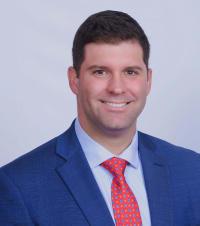
Christian M. Gunneson
Top rated Insurance Coverage attorney in Tampa, Florida
Practice Areas:
Insurance Coverage,
Employment & Labor
Education Qualification:
Quinnipiac University School of Law
Practice Areas:
Insurance coverage,
Employment & labor
2502 North Rocky Point Drive, Suite 550Tampa, Florida, 33607
First Admitted: 2012, Connecticut
Professional Webpage: https://www.fmglaw.com/lawyers/christian-m-gunneson/
Honors:
- Best Lawyers: Ones to Watch recognition for Insurance Law in Tampa, FL, Best Lawyers: Ones to Watch, Best Lawyers in America, 2024
- Certified Litigation Management Professional by the Claims and Litigation Management Alliance, CLM, 2023
- Best Lawyers: Ones to Watch recognition for Insurance Law in Tampa, FL , Best Lawyers: Ones to Watch, Best Lawyers in America, 2023
Scholarly Lectures / Writings:
- On August 30, 2023 the United States Department of Labor announced a notice of proposed rulemaking that would extend overtime pay to an additional 3.6 million salaried workers. In a nutshell, the proposed rule guarantees overtime pay for previously exempt salaried workers who earn less than $1,059 per week, or about $55,000 per year. This proposed change revises section 13(a)(1) of the Fair Labor Standards Act (FLSA), which exempts minimum wage and overtime pay requirements for certain executive, administrative and professional employees. It also provides for an automatic updating mechanism that streamlines the process to update and accurately reflect current earnings data., Author, NEW DEPARTMENT OF LABOR PROPOSED RULE WOULD EXTEND OVERTIME PAY FOR OVER 3.6 MILLION LOWER-EARNING SALARIED WORKERS, WSHB Legal Insider, Businesses, 2023
- Can you sue a business for violations of the Americans with Disabilities Act even if you've never actually patronized it? Federal appellate circuits around the country have answered this question differently. To resolve this circuit split, the United States Supreme Court granted certiorari in the case of Laufer v. Acheson Hotels, LLC, 50 F.4th 259 (1st Cir. 2022). The case involves the question of whether or not a plaintiff has standing under the Americans with Disabilities Act ("ADA") to sue a hotel for failing to provide information regarding its accessible accommodations. The plaintiff – who never planned to stay at the hotel and never visited the property – claimed she had "standing," or the legal ability to file a lawsuit, because she qualified as someone who "tested" whether businesses around the country violated the ADA, Co-Author, SUPREME COURT SHOWDOWN: ADA STANDING IN CROSSHAIRS, WSHB Legal Insider, Businesses, 2023
- Professional malpractice claims in the construction industry present unique questions with respect to statute of limitations issues. One particular challenge practitioners often encounter is determining which statute of limitations applies to each claim. When problems occur on a construction site, owners and developers often involve their design professionals and expect that they will be held at least partially responsible for any legal losses. In the last decade, Florida courts have produced conflicting opinions on the issue of the proper statute of limitations to apply to professional malpractice claims brought against design professionals such as architects and engineers. This issue recently took center stage in the case of American Automobile Ins. v. FDH Infrastructure Services, LLC, No. 3D22-1143 (Fla. 3d DCA, May 31, 2023), where the Florida Third District Court of Appeal grappled with the question of whether the two-year statute of limitations for professional malpractice claims or the four-year statute of limitations for actions related to the design, planning, or construction of real property improvements would govern., Co-Author, STATUTE OF LIMITATIONS CONUNDRUM: UNTANGLING PROFESSIONAL MALPRACTICE CLAIMS IN THE CONSTRUCTION INDUSTRY, WSHB Legal Insider, Construction, 2023
- n January 13, 2022, the Supreme Court granted the applications from parties who challenged the Emergency Temporary Standard (ETS) from the Occupational Safety and Health Administration (OSHA) that required employers with one hundred or more employees to, among other things, compel employees to either obtain the COVID-19 vaccine or test weekly for presence of the virus and wear a mask in the workplace. The Supreme Court did not rule on the actual merits of the ETS but instead granted an injunction that prevents the ETS from taking immediate effect while litigation on the merits of the ETS proceeds in the lower courts. In so doing, a majority of the Court (six judges) found that the ETS was, on its face, a general public health measure as opposed to an “occupational safety or health standard.” The statutes speaking to OSHA’s statutory power only regulate it to address the latter. OSHA’s attempt to regulate COVID-19 – which is present everywhere – would improperly expand its power to regulate the “hazards of daily life.” The Court would ultimately state that, “[a]lthough Congress has indisputably given OSHA the power to regulate occupational dangers, it has not given that agency the power to regulate public health more broadly.” At the same time, a majority of the Court (five judges) allowed the Centers for Medicare and Medicaid Services (CMS) to enforce its “vaccine mandate” nationwide while litigation on the merits of that “mandate” continues. Around the same time that OSHA’s ETS went into effect, the Secretary of Health and Human Services announced that facilities that receive Medicare and Medicaid funding must ensure that their staff is vaccinated from COVID-19. The Supreme Court today found that those challenging the CMS mandate were not likely to succeed on the merits because the Secretary has broad powers to impose conditions upon recipients of federal funds., Author, SUPREME COURT PREVENTS OSHA “VACCINE OR TEST” STANDARD FROM TAKING IMMEDIATE EFFECT BUT ALLOWS HEALTHCARE WORKER MANDATE TO STAND, WSHB Legal Insider, Businesses, 2022
- For over a year now, Americans with Disabilities Act (ADA) website accessibility cases in federal district courts in Florida, Georgia, and Alabama have been at a near standstill pending an appeal to the Eleventh Circuit Court of Appeals in the matter of Gil v. Winn Dixie Stores. The appeal sought review of a trial court’s judgment that Winn Dixie’s website violated the ADA by not providing sufficient technology to allow a vision-impaired customer access to the website’s virtual offerings that he would have then used in the physical store location. On April 7, 2021, the Eleventh Circuit vacated judgment, holding that under the ADA, Winn Dixie’s website was not a “place of public accommodation.” The decision at the Eleventh Circuit was reached by only a panel of three judges. The plaintiff then asked the Eleventh Circuit to rehear the case en banc, or to have all of the Eleventh Circuit judges decide the case again. On December 28, 2021, the Court granted plaintiff’s request but then dismissed the matter entirely., Author, ADA WEBSITE ACCESSIBILITY CASES IN FLORIDA, GEORGIA, AND ALABAMA: BACK TO SQUARE ONE?, WSHB Legal Insider, Businesses, 2022
- In its first comprehensive overhaul of the prevailing wage provisions of the Davis-Bacon Act in over 40 years, the Department of Labor (DOL) issued a new ruling that alters how prevailing wages for federally-funded or sponsored construction projects are calculated. On August 8, 2023, the DOL announced the issuance of the final rule entitled "Updating the Davis-Bacon and Related Acts Regulations." This final rule aims to redefine how prevailing wages and benefits are determined in federally-funded or assisted construction projects. This will vastly impact how construction workers are compensated., Co-Author, DAVIS-BACON ACT PREVAILING WAGE MODIFIED FOR CONSTRUCTION WORKERS, WSHB Legal Insider, Construction, 2023
- With the number of COVID-19 cases on the steady decline, many jurisdictions are celebrating as the pendulum swings from pandemic to endemic. For many, the turning point was seeing pictures of politicians without masks at NFL playoff games. In one instance, Los Angeles Mayor Eric Garcetti excused his behavior by claiming that he was “holding his breath.” This photograph, and others, are cited as a flashpoint of a gradual rollback of remaining COVID restrictions around the country. On February 17, 2022, California Governor Gavin Newsom released California’s plan for living with COVID-19 moving forward, called the SMARTER Plan. The SMARTER acronym stands for Shots, Masks, Awareness, Readiness, Testing, Education and Rx, or mediations. The goal of the SMARTER Plan is to avoid future business closures or interruptions should the state be faced with another variant arising or surge in cases. Other states have mostly lifted COVID restrictions and declared themselves “fully open.” A few states and counties still impose mask mandates indoors, mainly for the unvaccinated, but these restrictions are now the exception rather than the rule. Recommendations for the unvaccinated to take additional precautions are still in place nationally, however, and those who test positive are still required to stay home and isolate until five days after symptoms subside., Author, PENDULUM SWING FROM PANDEMIC TO ENDEMIC: WHAT IT MEANS FOR YOUR BUSINESS, WSHB Legal Insider, Businesses, 2022
- In the past several years, Florida homeowners have accounted for somewhere between 65 to 80 percent of all property lawsuits filed nationwide. In just this calendar year, insurers in the Florida market have either stopped writing business or have gone under. For instance, since February 2022, at least three insurers – Lighthouse Property Insurance, Avatar Property & Casualty, and St. John’s Insurance Co. – have been declared insolvent. In an attempt to stabilize the marketplace, a few weeks ago, in a special session called by Governor Ron DeSantis, the Florida legislature passed a slew of new reforms. These new laws (SB 2-D and SB 4-D (not at issue in this article) are now in effect as they were signed by the Governor on May 26, 2022. This article focuses on the law’s three most impactful changes to the litigation landscape. We also specifically focus on mechanics of how the legislature tried to make those changes. Those three key areas are: (1) attorneys’ fee recovery in assignment of benefits lawsuits; (2) plaintiff fee multiplier recovery; and (3) elements underpinning statutory “bad faith” recovery., Co-Author, FLORIDA LEGISLATURE ATTEMPTS TO “COOL” A WHITE HOT PROPERTY LITIGATION MARKET, WSHB Legal Insider, Insurance, 2022
- In Regan Heating and Air Conditioning, Inc. v. Arbella Protection Insurance Company, Inc., No. 2020-170-Appeal (Jan. 27, 2023), the Rhode Island Supreme Court, on the facts before it, expanded the obligations of insurers to examine potential policy ambiguities. In short, the Court found that "diversity of judicial thought" as to the meaning of insurance policy language is "proof positive of ambiguity." The implications for insurers are unclear at the moment, but at least on these facts – whether oil was a "pollutant" and thus losses arising from an oil spill were excluded – the Court has now determined that insurance policy contract language may be considered ambiguous where its treatment differs across various jurisdictions. This decision may now impose a duty on insurers to examine how other states treat relevant policy language before making coverage decisions., Co-Author, RHODE ISLAND SUPREME COURT: "DIVERSITY OF JUDICIAL THOUGHT" CAN MAKE POLICY LANGUAGE AMBIGUOUS, WSHB Legal Insider, Insurance, 2022
Contact Christian
All the below fields are required